
Filter
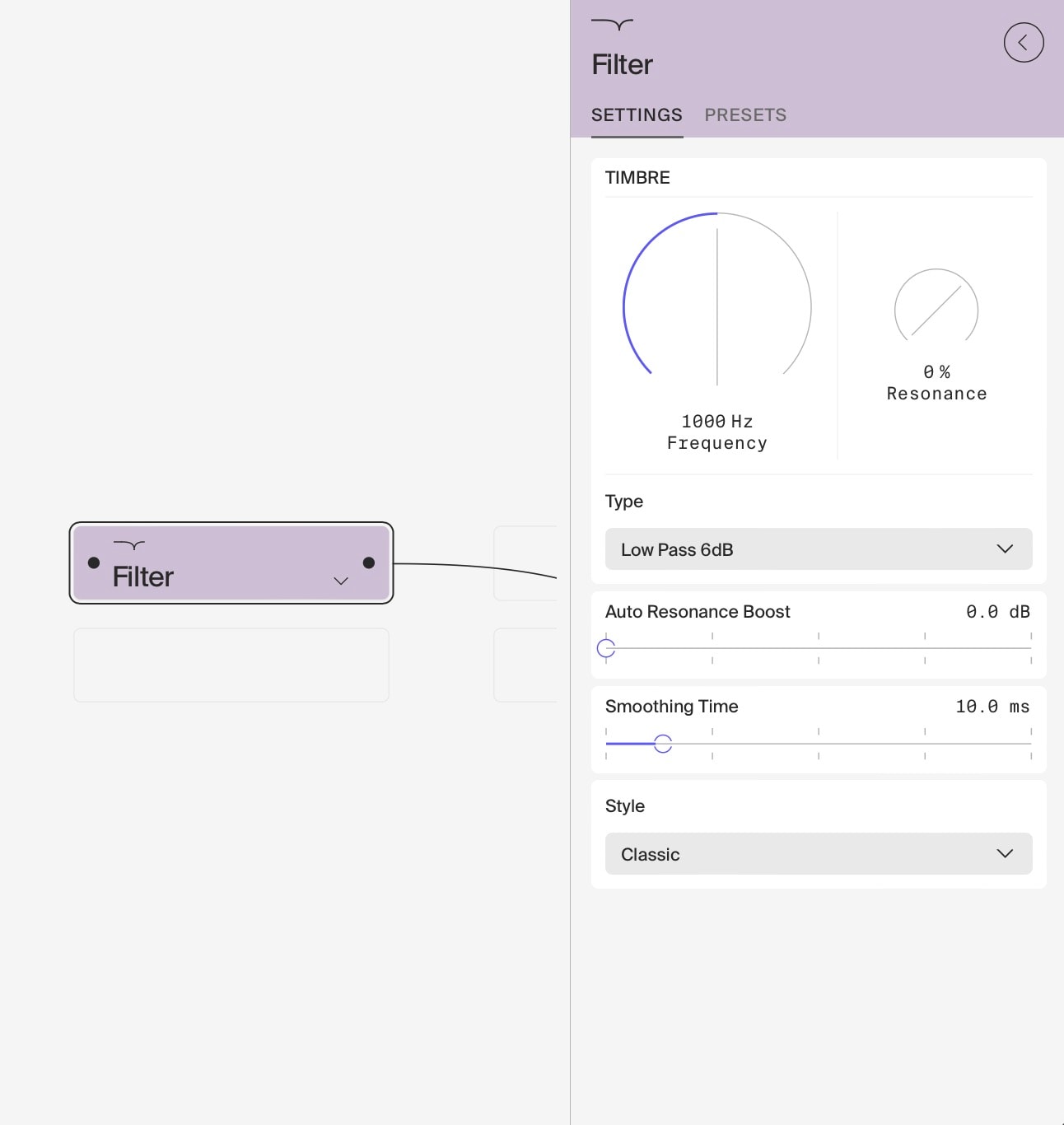
This module implements a classic 4-stage ladder filter, inspired by classic analog synthesizer design. It offers powerful sound shaping capabilities with a characteristic warm, analog-like response.
Key Features
- Filter Slope: 24 dB/octave (6 dB/octave per stage), providing a steep cutoff for dramatic sound sculpting.
- Resonance Control: Adjustable resonance that can self-oscillate when pushed to extreme settings.
- Cutoff Frequency: Wide range of cutoff frequencies for versatile filtering options.
- Auto Resonance Boost: A unique feature that compensates for low-frequency loss at high resonance settings.
- Smoothing Time: Adjustable parameter smoothing to reduce artifacts when modulating filter settings.
- Multimixing Settings:
- Low Pass: 6, 12, 18, 24 dB/octave
- High Pass: 6, 12, 18, 24 dB/octave
- Band Pass: 6, 12 dB/octave
- 4-pole Phaser
Usage Tips
- Classic Synth Sounds: Use high resonance settings with sweeping cutoff frequencies to create classic synthesizer effects.
- Self-Oscillation: Push resonance past 100% to create pitched oscillations. Note that a minimal noise floor (available in the Noise Generator module) is required to initiate oscillation. This effect can be used for sound design and generating musical tones. The frequency of the oscillation is approximately aligned with the set cutoff frequency but may vary depending on the input signal characteristics.
- Wah-Wah Effect: Modulate the cutoff frequency to create a classic wah-wah sound. This technique is particularly effective with thick, rich sounds, adding expressive movement and depth.
- MIDI Controlled Resonance: Assign MIDI Control Change messages to the resonance parameter for expressive control during performance.
- Phaser Effects: Utilise the 4-pole phaser setting for classic sweeping phaser sounds. Modulate the cutoff frequency for traditional phaser effects.
- Bass Enhancement: Apply moderate resonance at low cutoff frequencies to emphasise and shape bass sounds.
- Sound Thinning: Use high cutoff frequencies to remove low-end for a thinner, more cutting sound.
- Smooth Modulation: Adjust the smoothing time for more musical transitions when automating or modulating filter parameters.
Advanced Techniques
- Multi-Mode Filtering: Experiment with different combinations of low pass, high pass, and band pass settings to create complex filter shapes.
- Resonant Bass Lines: Use high resonance with low cutoff frequencies on bass sounds, then sequence the cutoff for dynamic, squelchy bass lines.
- Formant Filtering: Create vowel-like sounds by carefully setting multiple instances of the filter to emulate formant frequencies.
- Feedback Loops: In a modular setup, try feeding the filter’s output back into itself (with caution) for unique, sometimes unpredictable effects.
Important Notes
- Signal Limiting: The filter incorporates a soft clipping mechanism to limit signals exceeding 0 dB. This is necessary to control self-oscillation, but it can affect very hot input signals. For the cleanest possible filtering of high-level signals, it’s recommended to reduce the gain before the filter and then boost it afterwards, or to use the Parametric Equaliser for precision filtering without distortion.
- Harmonic Content: The ladder filter is most effective with signals rich in harmonic content. Its impact on simple waveforms like sine waves is minimal. For best results and to fully appreciate the filter’s capabilities, use complex sounds with a wide frequency spectrum.
Caution: Filter Resonance
When using the filter, please be aware of the following important safety information:
- Extreme Level Increase: When the resonance exceeds 100%, the filter will self-oscillate. Self-oscillation can cause the output signal level to exceed 0dB, even if the input signal is as low as -80dB. This can result in an unexpectedly loud output.
- Hearing Risk: If you’re operating at low levels (e.g., -36dB) and suddenly introduce high resonance, the dramatic increase in volume can potentially damage your hearing.
- Headroom Awareness: The filter’s behaviour means that even with significant headroom in your signal chain, you can still produce dangerously loud levels.
- Gradual Adjustment: Always increase resonance gradually, especially when approaching or exceeding 100%, and monitor your levels closely.
- Volume Preparation: Before experimenting with high resonance settings, ensure your monitoring volume is set to a safe level.
Remember, the ladder filter can significantly alter your sound, especially at extreme settings. Start with subtle adjustments and increase intensity as needed. The combination of multiple filter modes, resonance control, and modulation options makes this an incredibly versatile module for sound design and processing.
Last updated on