
Distortion
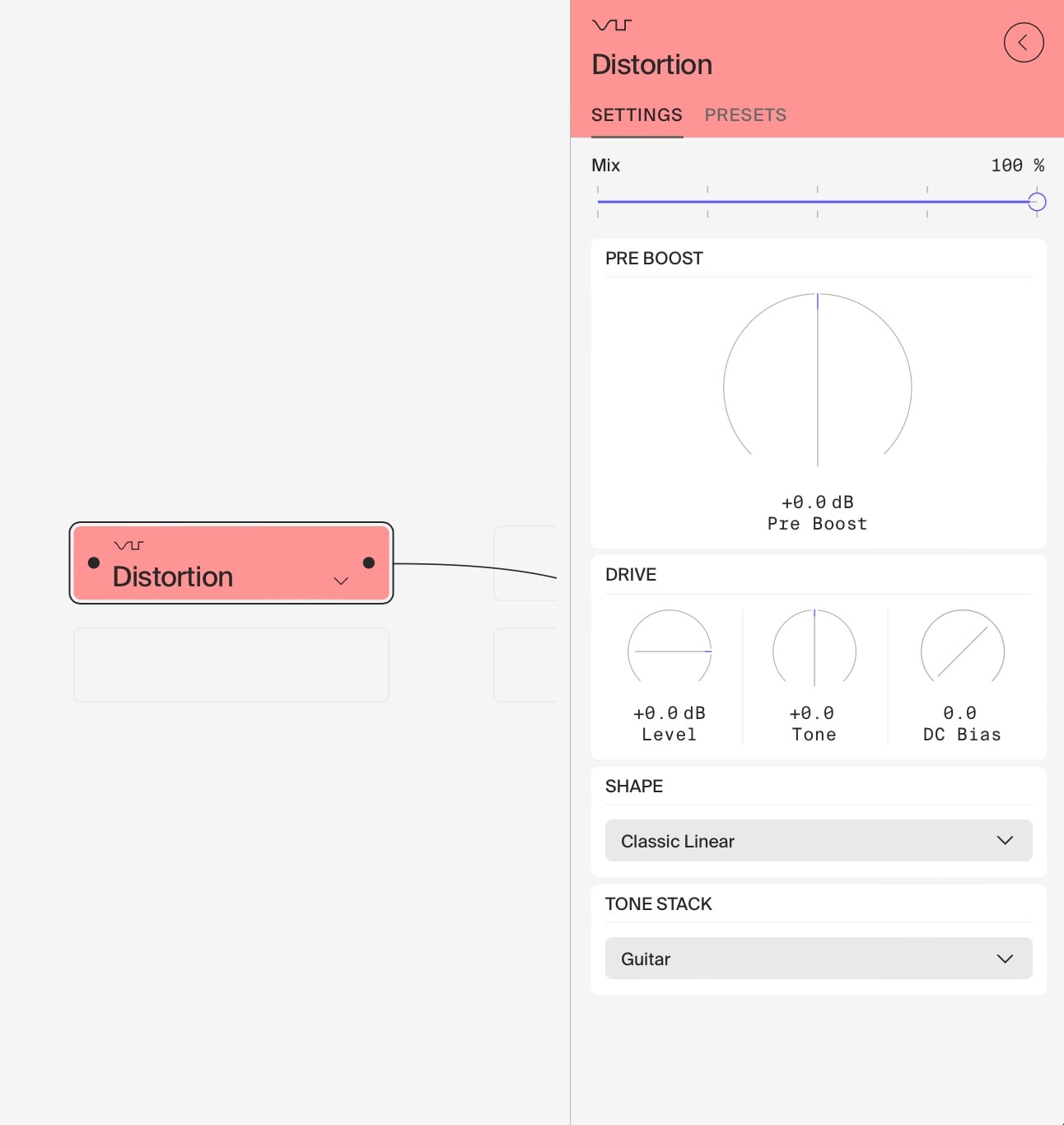
This advanced distortion module utilises wavetables to create a wide range of distortion effects, from subtle harmonic enrichment to aggressive, post-modern sounds.
Key Features
- Preboost and Level control
- Wavetable Distortion Types:
- Classic-soft (tanh distortion)
- Bit-crushers (for digital degradation effects)
- Broken amplifier models (for unique, unpredictable distortions)
- Asymmetric distortions (for adding even harmonics)
- Classic distortions (ranging from soft to fuzz and rectify styles)
- Octavers (capable of adding significant harmonic content and noise)
- EQ Options:
- None (flat response)
- Guitar (introduces pre and post equalization tailored for guitar)
- Tone Control:
- Enhances bass or treble
- 6dB lowpass at 1.2kHz and 6dB highpass at 50Hz
Usage Scenarios
- Subtle Harmonic Enrichment:
- Use classic-soft or mild asymmetric distortion
- Keep distortion amount low
- Experiment with the tone control for added warmth or presence
- Vintage Amp Simulation:
- Select a broken amplifier model
- Enable the Guitar EQ option
- Adjust tone for desired character
- Digital Destruction:
- Choose a bit-crusher distortion
- Increase distortion amount for more extreme effects
- Combine with high tone settings for added harshness
- Fuzz and Octave Effects:
- Use classic fuzz or octaver distortions
- Experiment with high distortion amounts
- Blend with the dry signal for thick, harmonically rich tones
Creative Techniques
- Split and Recombine:
- Use parallel processing with two or more distortion instances
- Apply different distortion types to each path
- Use filters (e.g., low-pass on one, high-pass on another) before the distortions
- Mix the processed signals back together for complex, layered distortion effects
- Pre and Post Equalization:
- Add a Parametric Equalizer before the distortion to shape the input signal
- Use another Parametric Equalizer after the distortion to fine-tune the distorted output
- This technique allows for precise control over which frequencies are distorted and how the final output is balanced
- Octave Layering:
- Use an octaver distortion with moderate settings
- Blend this with a classic distortion on a parallel path
- Adjust the mix to taste for a thick, harmonically rich sound with controllable noise levels
- Dynamic Distortion:
- Place a compressor before the distortion module
- Adjust the compressor’s settings to control how much of the signal hits the distortion
- This can create a more dynamic and responsive distortion effect
Caution
When using the Wavetable Distortion, please be aware of the following:
- Extreme Variations: The differences between wavetables can be extreme. Switching from a subtle, soft distortion to a fuzz or octave wavetable can result in dramatic level changes, even with low preboost settings.
- Input Sensitivity: The effect of distortion heavily depends on the input signal and level. Different playing techniques or input sources may require significant adjustments to achieve the desired result.
- Parameter Adjustment: To find the optimal sound for your intended playing technique, carefully adjust the preboost and level parameters. These controls are crucial for managing the intensity of the distortion and the overall output level.
- Gradual Exploration: When experimenting with different wavetables, it’s recommended to start with lower preboost and level settings, gradually increasing them to avoid unexpected volume spikes.
- Monitoring: Always monitor your levels closely, especially when switching between wavetables or adjusting parameters, to prevent potential damage to your ears or equipment.
Remember, the key to getting the most out of this distortion module is experimentation. Don’t be afraid to push the boundaries and combine different techniques. The wide range of distortion types, combined with the EQ and tone controls, offers virtually limitless possibilities for sound design and signal processing.
Last updated on